From conservative care to TenJet® percutaneous tenotomy — a complete treatment guide
Chronic heel pain from plantar fasciitis has a well-established treatment progression. When conservative measures don't resolve the pain, TenJet® percutaneous tenotomy offers a minimally invasive option that addresses the root cause — without surgery.
Find a Specialist View Treatment OptionsPatient Experience
This account comes from a TenJet patient and covers both the procedure and the recovery period afterward.
TenJet Patient Testimonial
Video courtesy of HydroCision, Inc., the maker of TenJet®. Individual results vary; this patient's experience is not a guarantee of outcome. Talk with a specialist about whether the procedure is appropriate for you.
Plantar fasciitis is degeneration of the plantar fascia — the fibrous band of tissue running along the sole of the foot from the heel bone to the base of the toes. The pain is typically worst with first steps in the morning and after periods of rest, then may ease somewhat with movement before returning with prolonged activity.
Research increasingly identifies plantar fasciitis as a degenerative condition rather than a purely inflammatory one. The plantar fascia develops microscopic tears and disorganized collagen, weakening the tissue and making it a persistent pain generator. This is why anti-inflammatory medications and cortisone injections often provide only temporary relief — they do not address the degenerated tissue itself.
Rest, ice, stretching exercises (calf and plantar fascia), supportive footwear, and over-the-counter orthotics. Most insurers require this stage first.
Targeted eccentric loading exercises, ultrasound therapy, manual therapy, and custom orthotics under physical therapist supervision. Effective for many patients at 6–12 weeks.
Corticosteroid or platelet-rich plasma (PRP) injections to reduce pain and promote tissue healing. Provides temporary to moderate-term relief in many patients.
For patients who haven't responded to conservative care, TenJet® removes the degenerated plantar fascia tissue directly — a 15-minute office procedure under local anesthesia with no surgery required.
TenJet® by HydroCision is a minimally invasive system that removes degenerated soft tissue through a small incision using a precisely directed, high-pressure saline stream. For plantar fasciitis, it targets the degenerated plantar fascia at the heel insertion — the area where most chronic pain originates.
Official product information: hydrocision.com/product/tenjet/
Official demonstration video from HydroCision, the maker of TenJet, plus a look at how tendinitis differs from the deeper tissue degeneration TenJet is designed to treat.
TenJet for Achilles & Plantar Fascia Tendinopathy — Procedure Technique


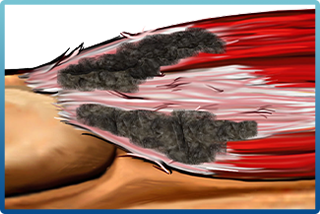
Diagrams and video courtesy of HydroCision, Inc.
Common Questions
Not strictly — it is a thick band of connective tissue rather than a tendon, but it degenerates in a similar way and responds to the same percutaneous approach.
The fascia shortens overnight and is then loaded abruptly on standing. That characteristic first-step pain is one of the more reliable diagnostic clues.
The chronic degenerative form, as distinct from acute inflammatory fasciitis. The distinction matters because degenerated tissue does not respond to anti-inflammatory treatment the same way.
In one published case the patient wore a walking boot for two weeks, began therapy, was pain-free at three months and completed a 5k about eight weeks after that.
This information is general and is not medical advice. Whether any procedure is appropriate for you can only be determined by a physician who has examined you and reviewed your imaging.